

SALE


Showing 19-20 Results(Total 20 Results)
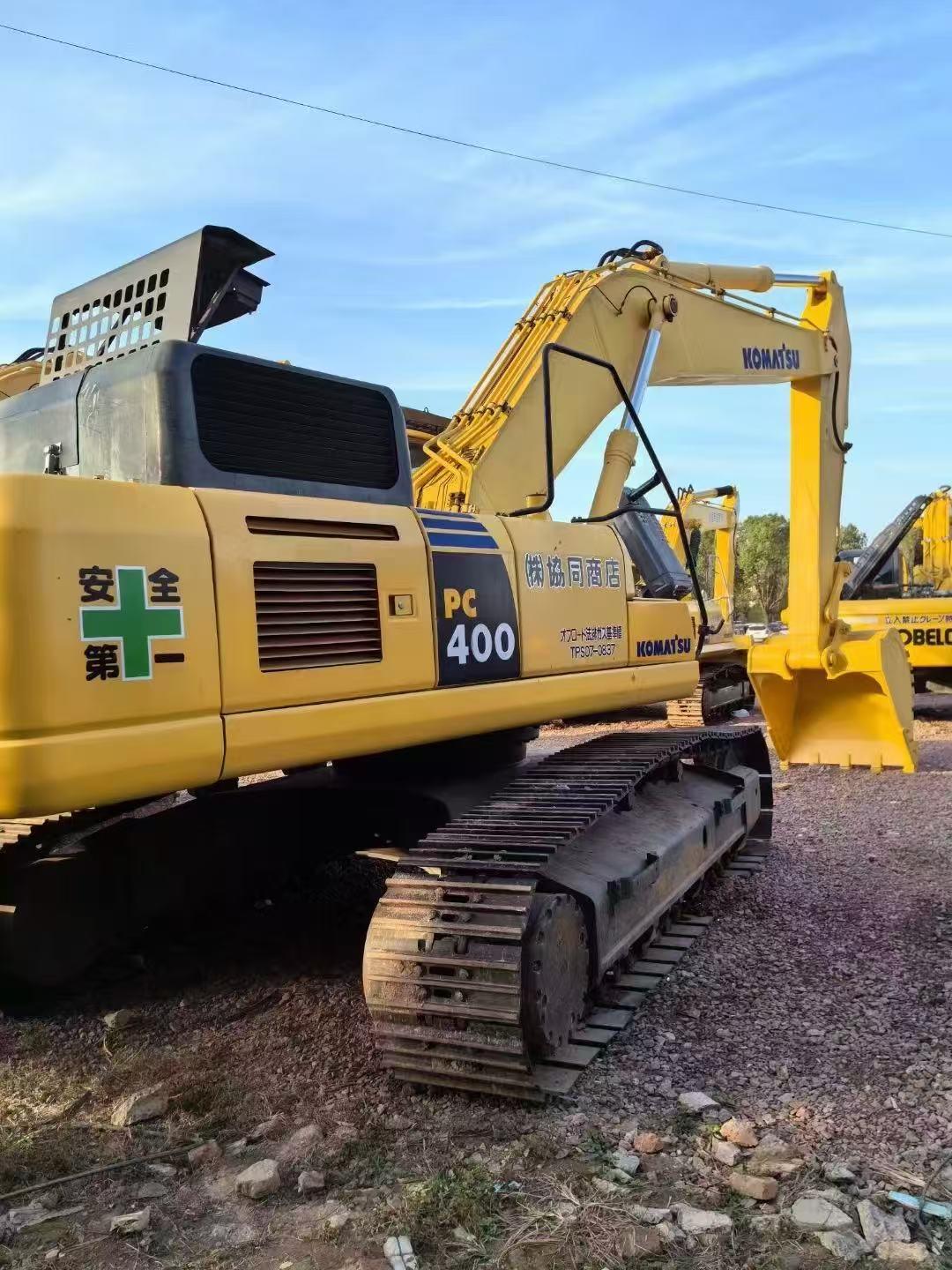
The Komatsu PC400-7 is a 40-ton class hydraulic excavator with the following core specifications:
| Parameter | Value |
|---|---|
| Operating Weight | 41,200 – 42,400 kg (standard version) / 42,200 – 43,500 kg (LC long undercarriage version) |
| Engine Model | Komatsu SAA6D125E-3 |
| Engine Type | 4-cycle, water-cooled, 6-cylinder in-line, direct injection, turbocharged with aftercooler |
| Net Horsepower | 246 kW / 330 HP @ 1,850 rpm |
| Displacement | 11.045 L |
The PC400LC-7 variant features a longer track frame (5,355mm vs 5,055mm total track length) and wider shoe options (700mm vs 600mm), providing better stability and lower ground pressure (65.3 kPa vs 77.7 kPa) for soft ground conditions . The LC version is approximately 1,200-1,300 kg heavier than the standard version.
Tip for buyers: When inspecting a used unit, verify the serial number plate to confirm whether it is a standard PC400-7 or PC400LC-7, as this significantly affects machine stability and transport weight calculations.
The Komatsu PC400-7 delivers impressive working ranges suitable for deep excavation and large-scale earthmoving:
| Working Range | PC400-7 / PC400LC-7 |
|---|---|
| Max. Digging Depth | 7,820 mm (25 ft 8 in) |
| Max. Digging Reach | 12,025 mm (39 ft 5 in) |
| Max. Digging Height | 10,915 mm (35 ft 10 in) |
| Max. Dumping Height | 7,565 mm (24 ft 10 in) |
| Max. Vertical Wall Depth | 6,870 mm (22 ft 6 in) |
With bucket capacity options ranging from 1.4 m³ to 2.0 m³ (standard range 1.4-1.9 m³) , the PC400-7 balances reach and payload efficiently. The maximum digging force with Power Max function engaged reaches 274.6 kN (28,000 kg) .
Operational note: The machine achieves a swing speed of 9.1 rpm and travel speeds of 3.0/4.4/5.5 km/h (Lo/Mi/Hi) . The “Mi” mode is available on multi-monitor specification machines for fuel-saving intermediate travel.
The PC400-7 is engineered for fuel efficiency while maintaining high productivity. Here are the key consumption and capacity data:
| Item | Specification |
|---|---|
| Min. Fuel Consumption | 203 g/kWh (151 g/HP·h) |
| Fuel Tank Capacity | 651 L (172 gallons) |
| Hydraulic System Capacity | 248 L (66 gallons) |
| Engine Oil Capacity | 38 L (10 gallons) |
| Cooling System Capacity | 34 L (9 gallons) |
| Swing Drive Capacity | 16 L (4 gallons) |
The closed-center load sensing system (CLSS) hydraulic system uses two variable displacement piston pumps (HPV190+190) delivering 345 L/min × 2 flow at 37.8 MPa (380 kg/cm²) set pressure . This system provides precise flow control—flow matches demand, reducing parasitic losses and improving fuel economy by 5-10% compared to conventional open-center systems.
Real-world estimate: Typical fuel burn ranges from 20-28 L/hour under normal digging conditions, depending on attachment type and operator technique. The 651L tank provides approximately 23-32 hours of continuous operation between refuels.
Based on field service data, hydraulic system issues on the PC400-7 typically fall into three categories:
| Problem | Common Causes | Repair Solution |
|---|---|---|
| Hydraulic oil leaks | Worn U-cup seals, improper seal installation, damaged sealing surfaces | Replace with genuine Komatsu seal kits; inspect sealing groove dimensions before installation |
| Low power / slow operation | Failed self-pressure reducing valve, worn servo PC valve assembly | Check self-reducing pressure (normal range: 3.0-4.5 MPa); replace PC valve and spool if pressure is abnormal |
| No machine movement | Failed hydraulic pump regulator, pilot pressure loss, electrical controller issue | Follow systematic troubleshooting: check pilot pressure → measure pump output → inspect controller signals |
Daily: Check hydraulic oil level in sight glass; inspect for visible leaks around cylinders, swivel joint, and hoses
Every 250 hours: Take hydraulic oil sample for analysis (look for ISO 4406 cleanliness code targets)
Every 500 hours: Replace hydraulic return filter and pilot filter
Every 1,000 hours: Sample and test hydraulic oil; change if oxidation or contamination exceeds limits
Every 2,000 hours: Replace hydraulic tank breather filter
Every 4,000-5,000 hours: Complete hydraulic oil change (use Komatsu genuine oil or equivalent meeting KES 07.868 standard)
Proactive tip: Monitor the hydraulic oil temperature during operation. If consistently above 85°C (185°F) under normal load, investigate cooler bypass, fan speed, or oil viscosity issues before component damage occurs.
The PC400-7 accepts a wide range of attachments for 40-ton class excavators:
| Attachment Type | Typical Size/Weight | Applications |
|---|---|---|
| General Purpose Bucket | 1.4 – 2.0 m³ capacity | Earthmoving, loose material handling |
| Heavy-Duty Rock Bucket | 1.2 – 1.6 m³ capacity | Quarry, rocky ground, shot rock |
| Hydraulic Breaker | 3,500 – 4,500 kg class | Demolition, rock breaking, concrete recycling |
| Thumb (Hydraulic/Mechanical) | 40-ton class match | Material sorting, demolition debris handling |
| Grapple | 40-ton class match | Log handling, scrap metal, waste sorting |
| Compaction Wheel | 40-ton class match | Trench backfill compaction |
| Condition / Hours | Price Range (USD) | Typical Source Markets |
|---|---|---|
| Excellent (under 3,000 hrs) | $90,000 – $120,000 | Japan, Europe, North America |
| Good (3,000 – 6,000 hrs) | $65,000 – $90,000 | Japan, China, Europe |
| Fair (6,000 – 10,000 hrs) | $45,000 – $65,000 | China, Middle East, Africa |
| Working condition (10,000+ hrs) | $30,000 – $45,000 | Local auctions, Africa |
Note: A 2022 PC400-7 with only 700 hours was listed at approximately $24,000 USD from China —this is significantly below typical market value, so extreme caution is advised (verify machine authenticity and potential reconditioning history). LC models typically command a 5-10% premium over standard versions.
Verify hours against service records and wear patterns (unusually low hours for the year may indicate meter tampering)
Conduct hydraulic oil sampling to detect internal pump or motor wear (ISO 4406 code should be ≤ 18/16/13)
Inspect undercarriage wear: track shoe height, bushing wear, roller condition (40% of machine value can be undercarriage)
Check swing bearing for vertical and horizontal play (spec: ≤ 3mm)
Run full function test: cycle all hydraulic functions, listen for cavitation or binding, check swing smoothness
Review engine blow-by and perform cold start to check for internal wear