

SALE

Showing The Single Result
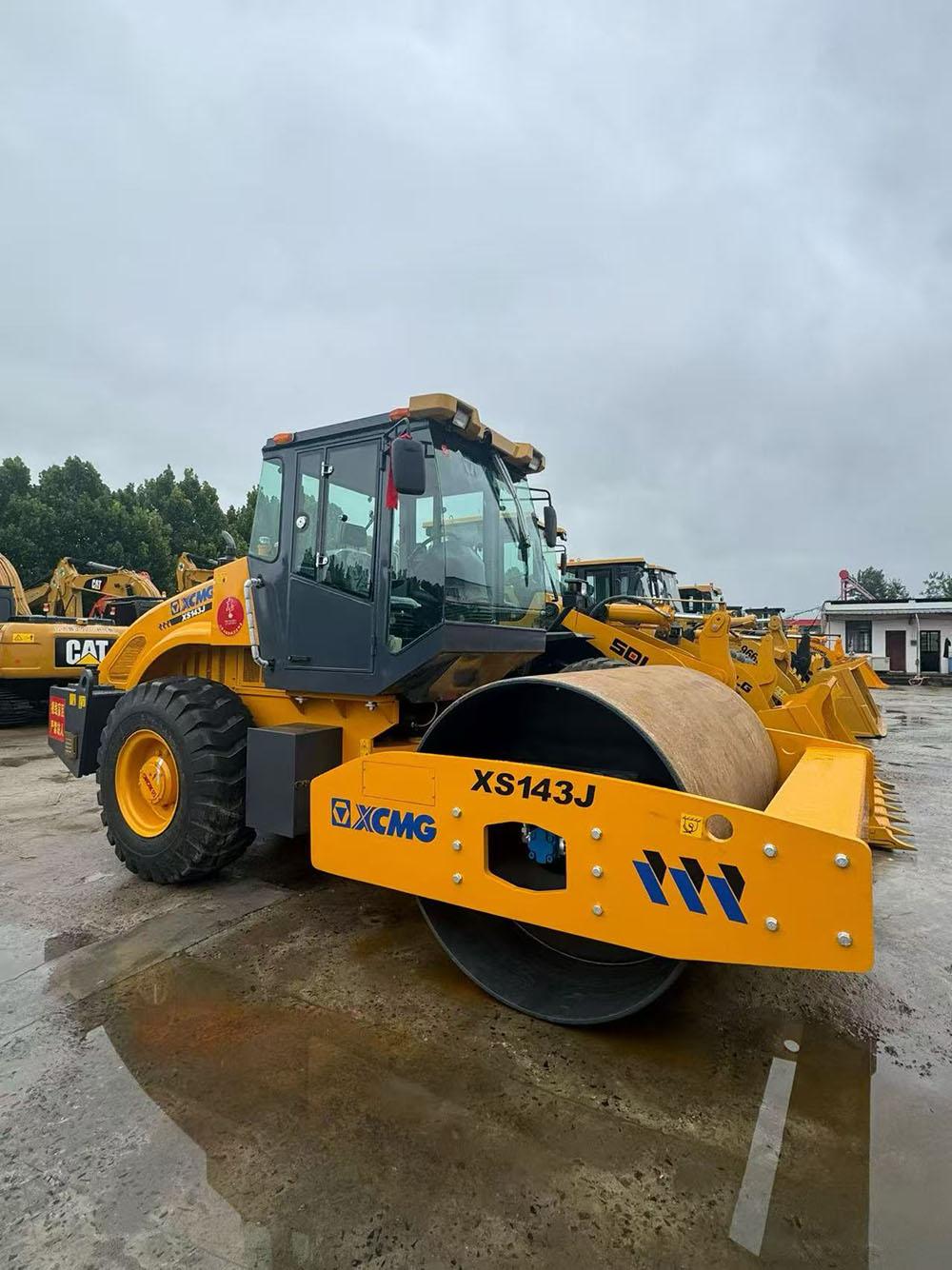
The XCMG XS143J is a 14-ton heavy-duty vibratory roller with a maximum working depth of 1.0 meter and above. This makes it fully capable of highway water-stabilized layer (cement-stabilized base) compaction—one of its primary application scenarios.
The machine delivers this depth capability through three key parameters:
| Parameter | Value |
|---|---|
| Operating Weight | 14,000 kg |
| Static Line Load | 315 N/cm |
| Exciting Force (High/Low) | 274/190 kN |
| Vibration Frequency | 28/33 Hz (dual-frequency) |
| Theoretical Amplitude | 1.9/0.95 mm (dual-amplitude) |
The combination of high static line load (315 N/cm) and high exciting force (up to 274 kN) ensures deep and uniform compaction. For highway water-stabilized layer construction, the low amplitude / high frequency mode (0.95 mm / 33 Hz) is typically used for surface finishing, while the high amplitude / low frequency mode (1.9 mm / 28 Hz) is applied for deep-layer compaction of thicker base courses.
Expert tip for used buyers: When inspecting a used unit, run a small test patch and check for uniform surface finish and absence of visible waves—these indicate the vibration system is still performing within spec.
The XS143J features a mechanical transmission with a synchronized gearbox, while many competing 14-ton rollers use fully hydrostatic drives. This is one of the most critical differentiators for used buyers to understand.
XS143J Mechanical Transmission Specifications:
Synchronized gearbox with 3 forward speeds (2.85 / 5.08 / 11.17 km/h) and 2 reverse speeds (2.88 / 5.02 km/h)
Heavy-duty dry single-plate friction clutch mounted directly on the flywheel
Pneumatic power-assisted clutch mechanism—greatly reduces pedal effort
Rear drum hydraulically driven via closed-loop variable piston pump and motor
Why this matters for used buyers:
| Aspect | Mechanical (XS143J) | Fully Hydrostatic |
|---|---|---|
| Repair Cost | Lower—gearbox and clutch components are widely available and cheaper to rebuild | Higher—pump/motor replacement is expensive |
| Field Serviceability | Easier—can be repaired by local mechanics in remote sites | More difficult—requires specialized hydraulic expertise |
| Operator Skill | Requires more skill for smooth shifting | Easier—single-lever operation |
| Parts Availability | Excellent—mechanical parts are globally stocked | Varies—proprietary hydraulic parts may have longer lead times |
Expert verdict: For contractors operating in developing markets or remote job sites where parts availability and field repairs are critical, the mechanical transmission of the XS143J is actually an advantage, not a drawback. However, used buyers should test-drive the unit—listen for gear grinding (indicates synchronizer wear) and clutch slipping (indicates clutch plate wear).
Based on field reports and maintenance guides, here are the top 5 issues to inspect on a used XS143J:
1. Vibratory Bearing Wear
The most critical component to check. The vibration system uses short cylindrical bearings with high rotational speed limits. While they are designed for low failure rates and can be lubricated during travel, they have a finite service life. Red flag: Unusual noise or knocking when vibration is engaged.
2. Gearbox Synchronizer Wear
The synchronized gearbox is durable but synchronizers wear with high-hour use. Red flag: Grinding noise when shifting gears—especially from 2nd to 3rd.
3. Clutch Condition
The heavy-duty dry clutch is reliable but subject to wear. Red flag: Slipping under load or chatter during engagement.
4. Loose Bolts and Fasteners
Due to continuous vibration, bolts can loosen over time. Key areas: engine mount bolts, drive shaft bolts, and transmission mounting bolts. Red flag: Missing or obviously loose bolts—indicates poor prior maintenance.
5. Hydraulic System Leaks
The closed-loop hydraulic drive system uses variable piston pump and motor. Red flag: Oil residue around hydraulic connections, pump, or motor—leaks can lead to costly repairs.
Pre-purchase inspection checklist:
Test vibration at both frequencies—listen for bearing noise
Test-drive through all 3 forward gears—check for grinding
Inspect all bolts and fasteners—look for missing or loose ones
Check for hydraulic leaks—especially around pump and motor
Review service records—oil change intervals, filter replacements
Use a third-party inspection service like Mevas (operates in 20+ countries)
Expert note: A thorough pre-purchase inspection costs far less than repairing a failed hydraulic cylinder or replacing vibratory bearings.
The XS143J is powered by a Shangchai SC4H140.1G2—a water-cooled, 4-cylinder, 4-stroke, turbocharged, direct-injection diesel engine producing 103 kW (138 hp) at 1,800 rpm.
Fuel Consumption Data:
| Metric | Value |
|---|---|
| Specific Fuel Consumption | 235 g/kW·h |
| Fuel Tank Capacity | 240 L |
What 235 g/kW·h means in real terms:
At rated power (103 kW), the engine consumes approximately:
24.2 kg of diesel per hour at full load
At diesel density of ~0.85 kg/L, this equals roughly 28.5 L/hour at maximum output
In real-world compaction work (not continuous full-load operation), typical consumption is 15–22 L/hour depending on material type and vibration mode.
Competitor Comparison:
| Model | Engine Power | Specific Fuel Consumption | Fuel Tank |
|---|---|---|---|
| XCMG XS143J | 103 kW | 235 g/kW·h | 240 L |
| Typical 14T Competitor A | ~105 kW | ~245–255 g/kW·h | ~220 L |
| Typical 14T Competitor B | ~110 kW | ~240–250 g/kW·h | ~250 L |
Expert assessment: The XS143J’s 235 g/kW·h fuel consumption is competitive for its class. The H-series turbocharged diesel engine is specifically designed with large power reserve and energy-saving, noise-reducing features. The low-speed diesel engine design also reduces noise emissions while enhancing fuel efficiency.
For used buyers: Fuel efficiency tends to decrease with engine hours due to injector wear and carbon buildup. Request service records showing regular injector maintenance and fuel filter replacements.
The XCMG XS143J has been in production since 2021, so used units available today are typically 1–5 years old with 0–2,000+ operating hours.
Price Ranges (Indicative, in USD and RMB):
| Condition | Estimated Price (USD) | Estimated Price (RMB) |
|---|---|---|
| Higher hours / bulk purchase | $8,000 – $12,000 | ¥58,000 – ¥89,000 |
| Average condition / moderate hours | $12,000 – $18,000 | ¥89,000 – ¥130,000 |
| Low hours / excellent condition | $18,000 – $25,000+ | ¥130,000 – ¥180,000+ |
Note: Some listings show prices up to ¥182,747 for near-new units. Prices vary significantly by region and seller.
Key Factors Affecting Used Value:
| Factor | Impact on Price |
|---|---|
| Operating Hours | Primary determinant—lower hours command premium |
| Maintenance History | Documented service records add significant value |
| Overall Condition | Visible wear, rust, or damage reduces price |
| Geographic Location | Prices vary by regional supply/demand |
| Configuration | Optional features (e.g., air conditioning, closed hydraulic system) increase value |
| Bulk Purchase | Multi-unit purchases get volume discounts |
Valuation Tools:
LECTURA Valuation provides fair market price estimates for the XS143J based on individual machine parameters
Machinio and Mascus list active listings for price comparison
Expert buying advice:
Never rely on price alone—a below-market unit likely has hidden issues
Always verify hours—check against service records and physical wear (tire tread, drum condition, pedal wear)
Consider total cost of ownership—a $15,000 unit with 1,500 hours may be a better value than a $10,000 unit with 3,000 hours that needs $5,000 in immediate repairs
Get a third-party inspection—Mevas operates in 20+ countries and can verify condition before purchase