

SALE

Showing The Single Result
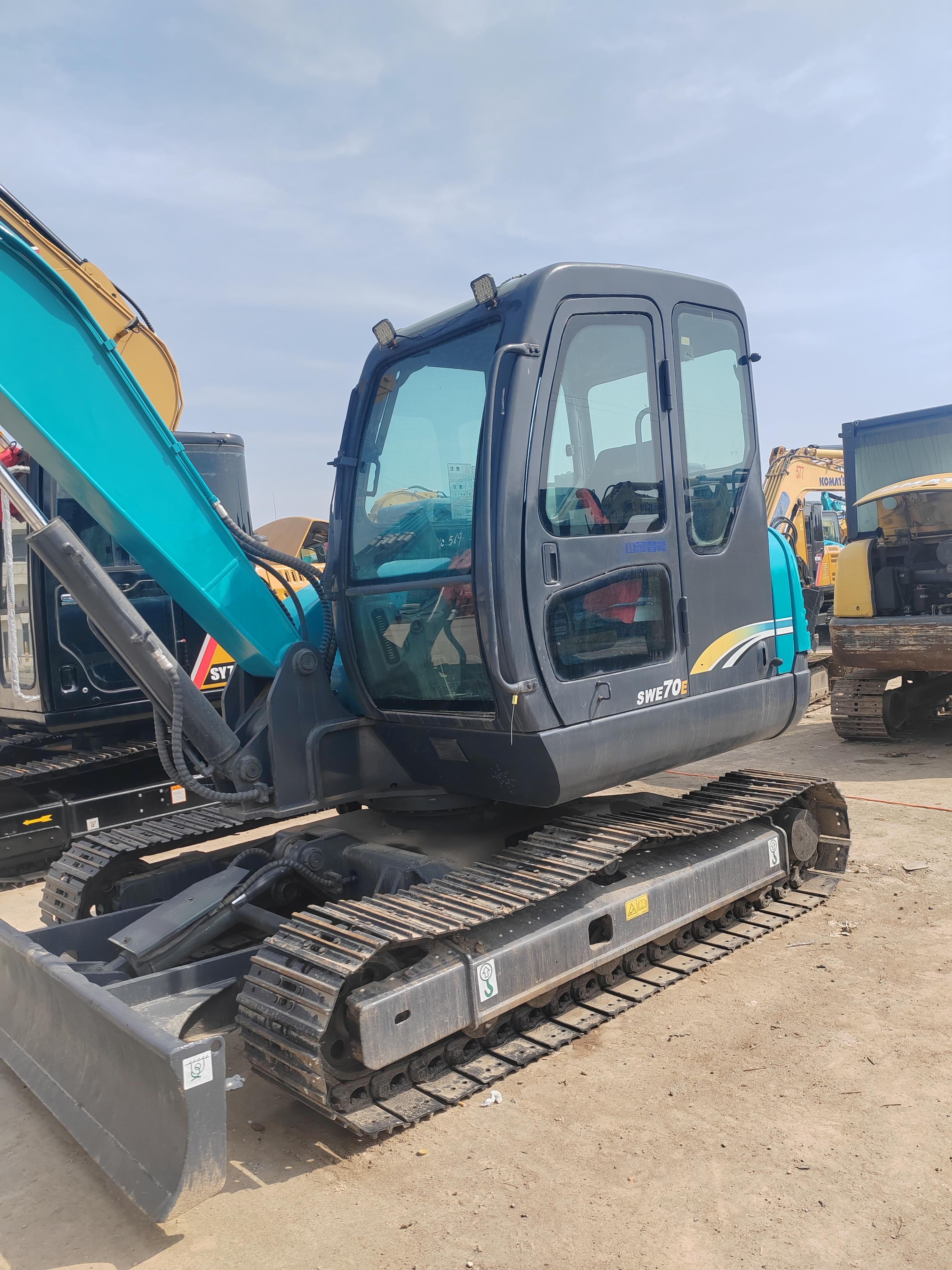
The Sunward SWE70 and SWE70E represent two generations of the same 7-ton mini excavator platform, and understanding their differences is absolutely critical when shopping for a used machine. The original SWE70 was manufactured from approximately 2006 through 2020, while the SWE70E is the upgraded version launched around 2020 and remains in production through the present day. The most significant and tangible difference lies in the digging force. The SWE70E delivers a bucket tearing force of 50 kN, compared to the original SWE70’s 44 kN. That is a 13.6 percent increase in breakout power, which translates directly into faster cycle times and less operator fatigue when working in compacted clay, rocky soil, or heavily rooted ground. The stick digging force also improved slightly from 31 kN to 31.5 kN. The dredging depth saw a major upgrade as well: the SWE70E reaches 4,015 mm, versus the older model’s 2,720 mm, giving you nearly 1.3 meters more reach below grade—a massive advantage when digging foundations or deep trenches. Both models share the same Yanmar 4TNV98 series engine platform, with output around 44 to 46 kW (approximately 59 to 63 horsepower) at 2,200 rpm. However, the SWE70E benefits from a refined triple-pump full-power variable hydraulic system that better matches engine output to demand, resulting in noticeably smoother combined movements and improved fuel efficiency per cubic meter of material moved. The cab on the SWE70E is significantly larger and more comfortable than the original. It meets updated FOPS and ROPS safety standards, features a two-stage adjustable suspension seat, and offers improved all-around visibility through larger windows. This is particularly important for operators spending long hours in the seat, as it reduces strain and improves job site safety. Both models share the same compact rear-end swing radius of 1,580 mm, which is a game-changer for urban job sites where space is tight. However, the SWE70E has a slightly wider track gauge for better stability during heavy lifting operations. Transport dimensions are nearly identical between the two generations: length of 5,910 mm, width of 2,080 mm, and height of 2,625 mm. Both fit easily on standard low-bed trailers without requiring special permits. When buying used, the SWE70E typically commands a price premium of 15 to 30 percent over an equivalent-hour original SWE70. The extra investment buys you better digging performance, a more comfortable operator environment, improved fuel efficiency, and potentially higher resale value down the road. If your work involves frequent digging in hard soils, deep trenching, or long operator shifts, the SWE70E is well worth the premium. However, if your tasks are lighter—such as landscaping, utility work in soft soil, or occasional farm use—a well-maintained original SWE70 can still deliver solid, reliable service, provided you inspect the hydraulic system and undercarriage very carefully.
The Sunward SWE70’s real-world digging performance consistently exceeds expectations for a 7-ton class machine. Verified specifications include a maximum excavating depth of 4,015 mm (approximately 13.17 feet), a maximum digging radius of 6,225 mm (20.42 feet), a maximum unloading height of 4,200 mm (13.78 feet), and a maximum excavating height of 6,020 mm. The bucket capacity ranges from 0.13 to 0.30 cubic meters depending on the attachment selected, with the standard bucket typically holding 0.26 cubic meters. The bucket digging force of 50 kN and arm digging force of 31 kN allow the machine to power through compacted gravel, heavy clay, and even limestone fragments up to 150 mm in diameter without stalling. The hydraulic system operates at a main relief pressure of 24.5 MPa and uses dual variable displacement piston pumps, delivering a total flow that translates into smooth, responsive control. Operators frequently praise the machine for its coordinated boom and arm movements, which make fine grading and precision trenching remarkably accurate. Travel speeds are 2.3 km/h on the low range and 4.0 km/h on the high range, with a swing speed of 9 rpm, allowing efficient repositioning around busy job sites. In practical terms, an experienced operator can dig and load approximately 80 to 100 cubic meters of common earth per hour, depending on truck cycle times and site conditions. Fuel consumption averages 5 to 7 liters per hour under typical mixed-use conditions, which is highly competitive with Japanese and Korean counterparts in the same weight class. The 400 mm rubber or steel track shoes provide excellent flotation on soft ground, and the machine’s ground pressure is only about 33.9 kPa, significantly reducing the risk of sinking in muddy or marshy conditions. The traction force is rated at 50.4 kN, giving the machine impressive pulling power when needed. One limitation to note: while the SWE70 handles light to medium rock excavation adequately, continuous heavy rock work will strain the hydraulic system and accelerate component wear. For such applications, stepping up to a 9-ton or larger machine is advisable. Also, the machine’s digging force decreases slightly when the arm is fully extended, so for maximum breakout power, experienced operators keep the arm angle between 45 and 90 degrees. Overall, the SWE70 delivers reliable, productive performance for residential foundations, utility trenching, landscaping, municipal maintenance, and agricultural drainage projects.
Like any used excavator, the Sunward SWE70 has a few well-documented weak points that buyers absolutely must be aware of before making a purchase. The most frequently reported issue involves the hydraulic pump system, specifically the main variable piston pumps. On units with over 1,500 operating hours, some owners have experienced pump seal leaks, which lead to reduced hydraulic pressure, sluggish attachment response, and ultimately, costly repairs. Rebuilding a pump typically costs between 1,200 and 2,500 USD depending on parts and labor, so a thorough pump pressure test during inspection is absolutely essential. The swing gearbox is another common trouble spot. Listen carefully for grinding noises, unusual vibrations, or erratic rotation of the upper structure during swing operation. These symptoms may indicate worn bearings, damaged gear teeth, or insufficient lubrication. Leaking hydraulic fluid around the swing gearbox is another red flag. Replacing the swing gearbox assembly can run 800 to 1,500 USD, so this is a significant cost to factor in. The undercarriage components—including track chains, sprockets, rollers, idlers, and track adjusters—typically show significant wear after 5,000 hours of heavy use. Replacement of a full undercarriage set costs approximately 2,000 to 3,500 USD, so evaluate track tension carefully and measure track link wear with a caliper. The Yanmar 4TNV98 engine itself is highly reliable, often exceeding 10,000 hours with regular oil and filter changes. However, it requires a proper break-in during the first 50 hours of operation and strict adherence to recommended service intervals. Some units from the 2012 to 2015 production years have experienced minor turbocharger oil leakage, which can be fixed with a new seal kit at relatively low cost. Electrical issues are rare but can include faulty sensors, loose wiring connections, or blown fuses, particularly in machines that have been exposed to high humidity or excessive water. The operation manual explicitly states that the majority of machine problems are caused by impurities entering the hydraulic system. This is why regular filter changes—both fuel and hydraulic—and using only Sunward-recommended fluids are absolutely critical. Never mix oils of different grades or brands. The good news is that parts availability has improved significantly in recent years. Sunward has an extensive dealer network across Asia, Europe, South America, and over 100 countries worldwide. Many aftermarket suppliers also offer compatible components at competitive prices. To minimize risks, always request the machine’s complete service records and look for evidence of regular oil changes, hydraulic filter replacements, and greasing of pins and bushings. Avoid units with patchy or non-existent maintenance history, as neglected lubrication accelerates pin and bushing wear, leading to sloppy boom and arm movements that require expensive re-bushing or re-pinning jobs costing up to 1,000 USD per joint.
Understanding the total cost of ownership for a used Sunward SWE70 involves far more than just the initial purchase price. On the second-hand market, prices vary extremely widely based on age, condition, hours, and accessories. Older high-hour machines with over 10,000 hours can sell for as low as 3,600 to 6,700 USD, while well-maintained low-hour units with under 2,000 hours typically command 13,000 to 27,000 USD, depending on accessories like quick couplers, hydraulic thumbs, extra buckets, and cab upgrades. Beyond the initial investment, annual operating costs include fuel, routine maintenance, major repairs, insurance, and depreciation. Fuel consumption averages 5 to 7 liters per hour under normal working conditions. For a typical 1,200-hour working year, you will spend roughly 6,000 to 8,400 USD on diesel at current global prices. Routine maintenance consists of engine oil and filter changes every 250 hours, hydraulic oil and filter changes every 1,000 hours, and greasing of all pivot points every 50 hours. Annual parts and fluid costs range from 600 to 1,500 USD if you perform the work yourself, or 1,500 to 3,000 USD if you use a dealer. Major component replacements are infrequent but can be very costly. A hydraulic pump rebuild runs 1,200 to 2,500 USD, an undercarriage overhaul costs 2,000 to 3,500 USD, a swing motor replacement is around 800 to 1,200 USD, and a travel motor replacement can cost 1,000 to 2,000 USD depending on the specific model. Insurance for a used machine of this size typically costs 500 to 1,000 USD per year, and transportation costs average 300 to 600 USD per move depending on distance. Depreciation on a used SWE70 is relatively stable compared to new machines. After the initial drop from new price, a well-maintained unit loses about 10 to 15 percent of its value per year. This means you can recoup a significant portion of your purchase price if you sell after two or three seasons, making it a relatively safe investment. The total cost per operating hour, including fuel, routine maintenance, major repairs, insurance, and depreciation, ranges from 25 to 60 USD. This makes the SWE70 one of the more economical options in the 7-ton segment, particularly when compared to premium Japanese or European brands that command higher parts and labor costs. To keep ownership costs low and predictable, buy the newest, lowest-hour machine within your budget, insist on documented service history with verifiable records, and perform regular preventive maintenance without skipping intervals. Remember: replacing filters and fluids on time is far cheaper than repairing a ruined pump, damaged engine, or worn-out hydraulic system. Also consider purchasing from a reputable dealer that offers pre-sale inspection, third-party verification, and long-term spare parts support.
When inspecting a used Sunward SWE70, following this comprehensive, step-by-step checklist can save you from costly mistakes and expensive surprises. Start with the hour meter. Under 2,000 hours is considered low usage and generally indicates a well-preserved machine that has barely been broken in. Two thousand to 5,000 hours is moderate usage, requiring careful checks of all major systems. Five thousand to 8,000 hours means substantial use, and you should expect some wear on wear items. Over 10,000 hours is high-risk territory unless the price is very low and major components like the engine, hydraulic pump, and undercarriage have already been replaced. Next, examine the undercarriage in extreme detail. Measure track sag—it should be about 30 to 50 mm of slack at the center point. Check sprocket and roller wear by looking for sharp edges, flat spots, or uneven wear patterns. Uneven wear between the left and right tracks suggests the machine may have been operated on sloping ground, overloaded on one side, or poorly maintained. Inspect the track adjusters and final drives carefully for any signs of oil leaks. Move to the hydraulic system. Look under the machine for puddles, drips, or wet spots on the ground. Inspect all hydraulic hoses and fittings for cracks, chafing, or weeping fluid. Pay special attention to the swing gearbox area. Perform a cold start—this is one of the most important tests. The engine should fire within 3 to 5 seconds with minimal white or blue smoke. If the seller insists on warming up the machine before you arrive, that is a red flag. Let the engine idle and listen carefully for any unusual knocking, ticking, or metallic sounds. After warming up to operating temperature, test every hydraulic function one by one. Cycle the boom up and down, the arm in and out, the bucket curl and dump, the swing left and right, and the travel forward and backward. Each movement should be smooth, continuous, and responsive. Jerky motion, sluggish response, or excessive noise indicates air in the system, a worn pump, failing valves, or low fluid levels. Also test the swing brake by swinging the upper structure halfway and releasing the joystick. The machine should stop firmly without drifting more than a few degrees. Examine the cab and all controls thoroughly. Test the air conditioner, heater, radio, and gauge cluster for full functionality. Check the seat adjustment mechanism, safety belt, mirrors, and all window seals. Look at the bucket and attachment: check for worn cutting edges, cracked welds, loose pins, and excessive play in the linkage. Ask the seller for complete maintenance records—regular oil changes, filter replacements, and grease logs are green flags. Verify that the machine has CE and GOST certification labels, which are important for resale value and regulatory compliance in many international markets. Finally, take the machine for a test drive over varied terrain, including a small slope or incline, to test the travel motors, brakes, and overall drivetrain performance. If possible, hire an independent mechanic to run a full pressure test on the hydraulic system and a compression test on the engine. A professional pre-purchase inspection costing 200 to 400 USD is a small price to pay compared to the thousands you could lose on unexpected major repairs. Be prepared to walk away if anything feels off or if the seller is evasive about the machine’s history. The used equipment market has plenty of SWE70s available, so patience and thoroughness will pay off in the long run.