

SALE

Showing The Single Result
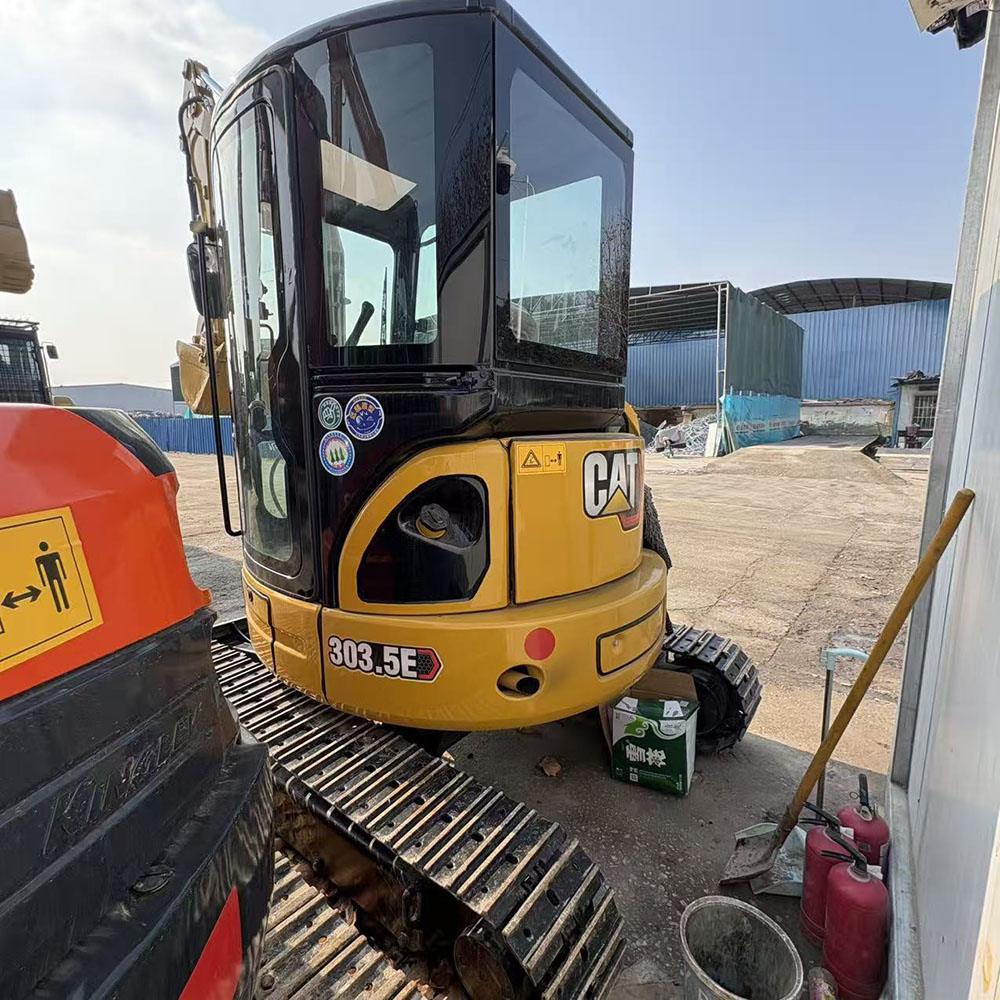
The CAT 303.5 has evolved across generations, but the core capabilities remain consistent. Below are the key specifications for the current Tier 4 Final / Stage V models, along with earlier variants:
Engine & Power
| Parameter | Current Model (C1.7) | Early Model (3013) |
|---|---|---|
| Engine Model | Cat C1.7 | Cat 3013 |
| Net Power (ISO 9249) | 17.6–18.4 kW (23.6–24.7 hp) | 19 kW (25 hp) |
| Gross Power | — | 20 kW (27 hp) |
| Displacement | 1.7 L (104 in³) | 1.5 L (91.3 in³) |
| Bore × Stroke | 84 mm × 100 mm | 84 mm × 90 mm |
| Emissions Standard | U.S. EPA Tier 4 Final / EU Stage V | Tier 2 / Stage II |
Weights
| Configuration | Weight |
|---|---|
| Minimum Operating Weight (Canopy) | 3,480 kg (7,673 lb) |
| Maximum Operating Weight (Canopy) | 4,050 kg (8,930 lb) |
| Minimum Operating Weight (Cab) | 3,620 kg (7,982 lb) |
| Maximum Operating Weight (Cab) | 4,190 kg (9,239 lb) |
| CE Plate Weight (Cab) | 3,630 kg (8,004 lb) |
The operating weight varies significantly based on configuration: rubber versus steel tracks (+130 kg), canopy versus cab (+140 kg), standard stick versus long stick (+20 kg), and the presence of an angle blade (+160 kg) or extra counterweight (+250 kg). Buyers should confirm which configuration they are evaluating.
Working Ranges
| Parameter | Standard Stick | Long Stick |
|---|---|---|
| Max Digging Depth | 3,160 mm (10.4 ft) | 3,110–3,560 mm (10.2–11.8 ft) |
| Max Reach at Ground Level | 5,170 mm (17.0 ft) | 5,380–5,540 mm (17.7–18.2 ft) |
| Max Dump Clearance | 3,490–3,570 mm (11.5–11.7 ft) | 3,600–3,800 mm (11.8–12.5 ft) |
| Max Cutting Height | 5,040 mm (16.6 ft) | 5,020–5,260 mm (16.5–17.3 ft) |
| Tail Swing (without extra counterweight) | 890 mm (35.0 in) | — |
| Tail Swing (with extra counterweight) | 1,005 mm (39.6 in) | — |
The compact tail swing design — ranging from 890 mm (without extra counterweight) to 1,005 mm (with extra counterweight) — is one of the 303.5‘s defining features, allowing it to work confidently near structures, walls, and traffic.
Travel System
| Parameter | Value |
|---|---|
| Travel Speed – High | 4.5 km/h (2.8 mph) |
| Travel Speed – Low | 2.6 km/h (1.6 mph) |
| Max Traction Force – Low Speed | 31 kN (6,969 lbf) |
| Max Traction Force – High Speed | 16.9 kN (3,799 lbf) |
| Ground Pressure – Min Weight | 29.6 kPa (4.3 psi) |
| Ground Pressure – Max Weight | 35.7 kPa (5.2 psi) |
| Gradeability | 30 degrees |
Hydraulic System
| Parameter | Value |
|---|---|
| Main Pump Flow (@ 2,400 rpm) | 100 L/min (26.0 gpm) |
| Primary Aux Circuit Flow | 70 L/min (18.0 gpm) |
| Secondary Aux Circuit Flow | 7 gpm (approx. 26.5 L/min) |
| Operating Pressure – Equipment | 206 bar (2,987 psi) |
| Aux Circuit Pressure | 245 bar (3,553 psi) |
| Bucket Digging Force | 33 kN (7,419 lbf) |
| Stick Digging Force – Standard Stick | 18.7 kN (4,200 lbf) |
| Stick Digging Force – Long Stick | 14.0 kN (3,150 lbf) |
| Swing Speed | 9.3 rpm |
Capacities
| Parameter | Value |
|---|---|
| Fuel Tank | 45 L (11.9 gal) |
| Hydraulic Tank | 20 L (5.3 gal) |
| Cooling System | 7 L (1.8 gal) |
| Engine Oil | Approx. 8 L |
Dimensions
| Parameter | Value |
|---|---|
| Overall Shipping Length | 4,850 mm (16.8 ft) |
| Overall Shipping Height | 2,480 mm (97.6 in) |
| Track Width | 1,780 mm (70.1 in) |
| Track Shoe Width | 300 mm (11.8 in) |
| Minimum Ground Clearance | 310 mm (12.2 in) |
Users consistently report that the CAT 303.5 delivers reliable power and efficiency, with smooth engine operation and quick response times across a variety of tasks. The advanced hydraulic system provides precise control and impressive lifting capabilities, making it suitable for both delicate landscaping work and heavier digging operations.
Operator comfort is a standout feature. The ergonomic cab offers excellent visibility — critical when working in confined urban environments — and an intuitive control layout. The cab is sound‑suppressed, and advanced viscous mounts reduce vibration significantly compared to older designs.
The compact tail swing design is a major operational advantage. The 303.5 CR (Compact Radius) allows the machine to swing within the width of its own tracks, enabling safe operation next to buildings, traffic, or existing structures without counterweight strikes — a feature that directly translates to reduced liability and expanded job site access.
Versatility through attachments is another key strength. The 303.5 is compatible with a wide range of attachments — buckets, hydraulic hammers, augers, grapples, thumbs, and compactors — making it adaptable for construction, landscaping, utility work, and light demolition. The auxiliary hydraulic circuit provides the flow and pressure needed for most compact attachment applications.
The CAT 303.5 is generally a robust and durable machine. However, several recurring issues have been documented by owners and technicians. Being aware of these can prevent unexpected downtime and expensive repairs.
1. Hydraulic System Issues. The most frequently reported problems across the 303.5 range involve hydraulic performance:
Low auxiliary circuit pressure for hammers. One owner reported that a 303.5 could not run a hammer attachment effectively, measuring only 250–500 psi in the auxiliary circuit when the system should deliver around 3,500 psi. The root cause was traced to the auxiliary relief valve — a known weak point on these machines.
Gradual hydraulic weakening during operation. A documented case describes a 303.5 that starts strong but loses hydraulic power progressively as it runs. The mechanic advised checking for fine metal particles in the return hydraulic filter (indicating pump wear), inspecting relief valves in the main control valve for debris or damaged O‑rings, and performing systematic pressure testing.
Weak hydraulics after valve bank rebuild. A forum post detailed a 303.5ecr that remained weak even after rebuilding the entire control valve stack. The issue turned out to be tiny shuttle check valves (described as “mystery discs”) that were not machined to perfect tolerances, preventing proper load sensing. After obtaining genuine Cat replacement parts, the machine performed “like new again”. The lesson: hydraulic tolerances on these machines are extremely tight, and aftermarket or self‑fabricated parts often do not meet specifications.
General hydraulic weakness. Common causes include low hydraulic fluid levels, worn pump components, clogged filters, and air ingress in suction lines.
2. Engine Starting Problems and Power Loss. Older machines, particularly higher‑hour units, may experience hard starts or reduced engine power due to clogged fuel filters, dirty air filters, or carbon buildup in the fuel system. Regular filter replacements and injector cleaning are essential preventive measures.
3. Hydraulic Leaks. As machines age, hoses harden, seals wear, and fittings loosen. Common issues with used 303.5 units include aging hoses, worn seals, or declining pump performance leading to low pressure or external leaks. Prompt replacement of worn seals and hoses is far less expensive than dealing with a failed pump due to fluid loss.
4. Slow or Unstable Boom and Bucket Movement. Delays or instability in the boom, bucket, or swing functions may result from dirty hydraulic oil, cylinder wear, or loose pins. Regular replacement of hydraulic fluid and filters, along with inspection of pivot pins and connections, prevents these issues.
5. Electrical System Issues. Used 303.5 excavators may encounter dashboard malfunctions, lighting failures, or control switch problems. Common fixes include checking battery connections and voltage, inspecting wiring for corrosion, and replacing faulty sensors or control modules.
6. Track and Undercarriage Wear. Worn or loose tracks can cause unstable movement or increased noise. Regular inspection of track tension, cleaning of mud and debris, and timely replacement of severely worn tracks or sprockets ensure safe and efficient operation.
The 303.5 was designed with extended maintenance intervals to reduce operating costs. According to Caterpillar, the 303.5 offers extended service intervals that not only reduce downtime but also decrease the amount of fluid and filters replaced over the machine‘s life.
Recommended Maintenance Intervals
| Component | Service Interval |
|---|---|
| Engine oil and filter (first change) | 100 hours |
| Engine oil and filter (subsequent) | Every 500 hours |
| Final drive oil (first change) | 250 hours |
| Final drive oil (subsequent) | Every 1,000 hours |
| Hydraulic oil (with Cat HYDO Advanced 10) | 3,000 hours |
| Hydraulic return filter | 3,000 hours |
| Coolant | 12,000 hours or 6 years |
| A/C or cab heater filter | Every 137 hours |
Estimated 5,000-Hour Maintenance Cost
| Maintenance Category | Estimated Cost (USD) |
|---|---|
| Engine oil + filter changes (10× at 500h) | $800–1,500 |
| Fuel filters (10× at 500h) | $200–400 |
| Hydraulic oil + filter change (1–2×) | $600–1,000 |
| Air filter replacements | $100–200 |
| Track shoes / sprockets / rollers (as needed) | $1,500–3,000 |
| Bucket teeth / wear parts | $500–1,500 |
| Hydraulic pump rebuild (if needed, 8,000–10,000h) | $1,500–3,000 |
| Labor (accumulated over 5,000h) | $1,500–3,000 |
| Estimated 5,000-hour cumulative cost | $6,700 – $13,600 |
Note: These are estimated ranges. Actual costs vary by region, parts pricing, operating conditions, and maintenance history.
The extended hydraulic oil interval (3,000 hours when using Cat HYDO Advanced 10 oil) represents a significant reduction in fluid and filter consumption compared to older designs. The engine oil and filter change interval of 500 hours is standard for this class but should be strictly followed to maintain engine longevity.
Serviceability features: The 303.5 incorporates practical design elements that reduce maintenance time:
Swing‑out rear door and side hood provide excellent access to regular service and maintenance points.
100% pilot controls maintain “as new” machine control and eliminate the need for linkage and cable maintenance.
Remote Flash capability minimizes downtime and maintenance time while keeping the asset running with maximum efficiency.
Diagnostic tools: When issues arise, Caterpillar‘s Cat ET (Electronic Technician) diagnostic software is invaluable. It can detect fault codes across the engine, hydraulic system, and electrical system, providing detailed fault information that speeds troubleshooting.
Used CAT 303.5 prices vary significantly by year, hours, condition, and region. The following data points are based on recent market listings:
| Year | Hours | Price (USD) | Notes |
|---|---|---|---|
| 2021 | — | $21,250 | Auction sale (IronPlanet, April 2025) |
| 2024 | 104 | ~$56,000 | Germany, low‑hour unit |
| 2024 | 511 | ~$44,500 | USA (Russellville) |
| 2002 | 3,347 | Sold at auction | Very early model, canopy |
In the Chinese market, the manufacturer‘s suggested retail price for a new 303.5ECR ranges from approximately 238,000 to 248,000 RMB (roughly $33,000–34,500 USD), depending on configuration (canopy vs. cab).
Price trends: A well‑maintained 2018–2021 303.5 with 2,000–3,000 hours typically falls in the $18,000–28,000 range. Low‑hour (under 1,000 hours) late‑model units (2022–2024) can reach $35,000–56,000 depending on configuration and market. Auction prices tend to be lower but carry higher risk, as condition is not always verified.
According to 2026 market analysis, a well‑maintained used Caterpillar mini excavator often retains strong value due to Cat‘s reputation for durability and the company‘s extensive dealer network.