

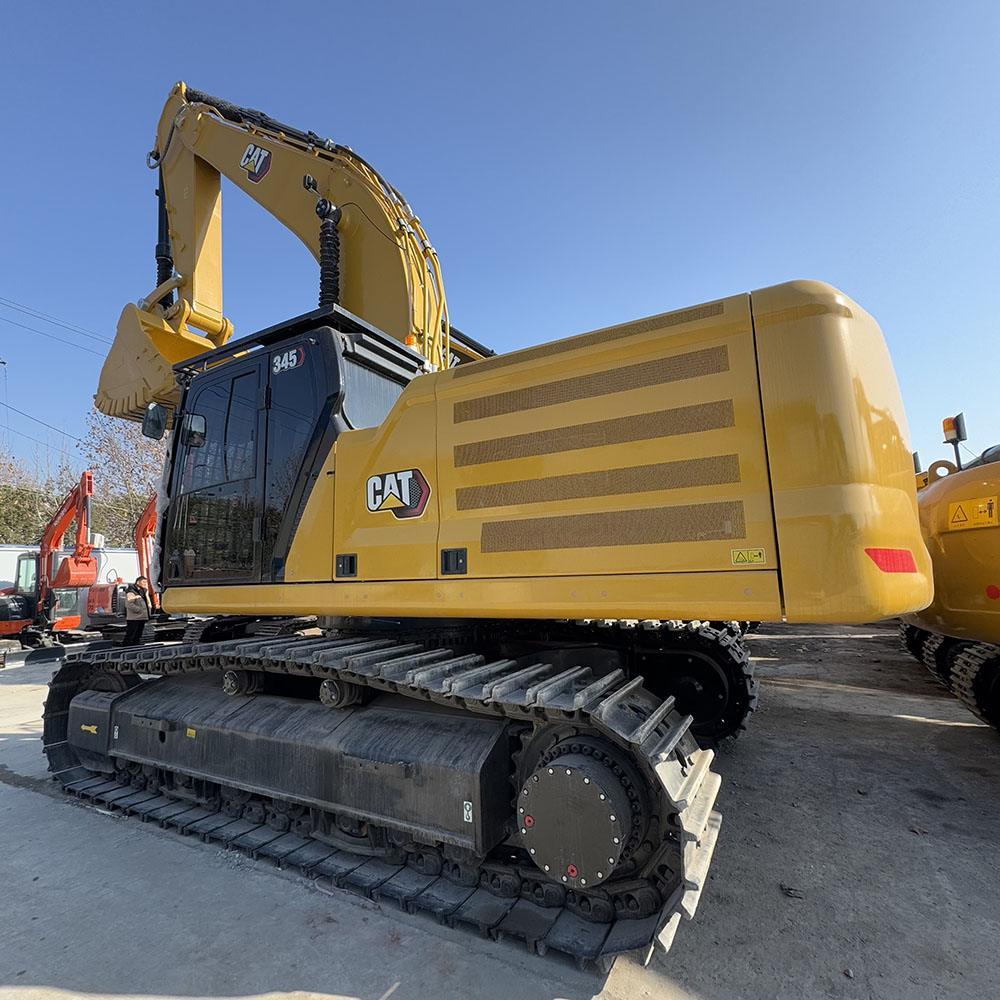
349D2

您在这里:

Product Categories

349D2

Frequently Asked Questions about 349D2 Excavator

A:

The 349D2 occupies a critical position in Caterpillar’s large excavator lineup — above the 336 (c.36 tons) and below the 350/352 (c.50+ tons) and 374/390 series. This places it squarely in the “heavy production” class: powerful enough for tough mining applications, yet still manageable for quarry work and mass earthmoving. The “D” represents the D‑series generation (c.2005 to mid‑2010s), and the “2” marks the Series 2 upgrade, which brought refinements in fuel efficiency, serviceability, and hydraulics relative to the original 349D. The “L” suffix (common on most variants) denotes a long undercarriage, which enhances stability for heavy lifting and provides better flotation in soft terrain.

The 349D2 was primarily targeted at quarry, mining, and severe‑duty applications. Its Cat C13 ACERT engine meets Tier 2 / EU Stage II (or, for later units, Tier 3 / Stage IIIA) emissions levels, meaning it requires no DEF (Diesel Exhaust Fluid) and no DPF (Diesel Particulate Filter). For used buyers, this is a significant advantage — reduced complexity, lower operating costs, and fewer emissions‑related downtime events compared to newer Tier 4 Final machines.

A:

The 349D2 is built around the Cat C13 ACERT™ diesel engine, a 12.5‑liter, 6‑cylinder, turbocharged inline engine that has been widely deployed across Caterpillar’s heavy equipment lineup. The engine delivers a gross power of 301 kW (403 hp) under ISO 14396, with a net flywheel power of 289 kW (387 hp) under SAE J1349/ISO 9249. Its displacement is 12.5 L, with a bore and stroke of 130 mm × 157 mm. The C13 was engineered with a mechanically actuated unit‑fuel‑injection system governed by electronic controls, which provides the high injection pressures needed for complete combustion and optimum fuel economy. At the same time, the system relies on fewer electronic components than later common‑rail designs, which simplifies troubleshooting.

The 349D2’s operating weight varies by configuration. The standard undercarriage version (which is rarely the primary market variant) weighs approximately 45,260–45,382 kg (99,800–100,100 lb). The vast majority of units available in the used market are 349D2 L (long undercarriage) models, weighing 46,520–48,185 kg (102,600–106,200 lb), depending on the counterweight, track shoe width, and other attachments. The long undercarriage provides a track length of approximately 5,360 mm (17.6 ft) for stability and a track gauge of 2,740 mm (approx. 108 in). Standard track shoes are 600 mm wide, with optional 750 mm and 800 mm widths available for lower ground pressure in softer conditions.

Hydraulic System and Performance: The 349D2’s load‑sensing hydraulic system is a standout feature. Two variable‑displacement main pumps deliver a total flow of 734 L/min (194 gpm) at a working pressure of 35,000 kPa (5,076 psi) for equipment and travel circuits. The system incorporates a hydraulic cross‑sensing design, meaning each pump can use 100% of engine power under all operating conditions, maintaining implement speed and pivot‑turn power. Regeneration circuits for the boom and stick also shorten cycle times and conserve fuel. This translates into impressive digging forces: the ISO bucket digging force is 267 kN (≈27.2 tonnes) , and the stick digging force is 201 kN (≈20.5 tonnes) . Swing speed is 8.7 rpm with a swing torque of 149 kN·m, while maximum travel speed is 4.5 km/h (2.8 mph) and drawbar pull is 338 kN.

Fuel Capacity and Fluids: The fuel tank holds 705 L (186 gal US) . The hydraulic system total capacity is 570 L (150 gal US), with a hydraulic tank of 243 L (64 gal US). Engine oil capacity is 42 L (11 gal US). Cooling system holds 35.5 L (9.4 gal US), final drives take 15 L (4.0 gal US) each, and swing drives take 10 L (2.6 gal US) each.

Working Ranges: With a standard 6.9 m reach boom and 3.35 m to 3.9 m stick, the 349D2 achieves a maximum digging depth of 7,150 mm, a maximum reach at ground level of 11,240 mm, and a maximum dumping height of 7,290 mm.

A:

The heart of the 349D2 is the Cat C13 ACERT engine — a 12.5‑liter inline‑6 that has earned a reputation for durability in heavy applications. Unlike newer Tier 4 Final engines, the C13 in the 349D2 does not require DEF (diesel exhaust fluid), DPF (diesel particulate filter), or EGR (exhaust gas recirculation) systems found on later machines. This simplifies maintenance significantly, reduces consumable costs, and eliminates common failure points that lead to unplanned downtime. The C13 was available in multiple emission configurations: early units meet U.S. EPA Tier 2 / EU Stage II standards, while later units meet Tier 3 / Stage IIIA. Either way, the engine relies on mechanical unit injectors (not common rail) and a more straightforward electronic control system, which used buyers should find easier and cheaper to maintain. On the downside, the C13 is less fuel‑efficient than newer, more modern engines, as the following section shows.

The engine incorporates Cat’s ACERT Technology — a combination of advanced fuel injection, air management, and electronic control systems designed to optimize combustion while meeting emission standards without aftertreatment. The ADEM A4 electronic control module manages fuel delivery based on load and operating conditions, helping the engine respond quickly while maintaining efficiency. The engine is also equipped with a radial seal air filter with a double‑layered filter core that provides more efficient filtration, and a warning appears on the monitor when dust accumulates above a preset level — a useful feature for dusty mining environments.

Real‑world fuel consumption: The fuel efficiency of the 349D2 is a mixed story. Official literature claims the machine can achieve up to 9% fuel savings in Economy Mode compared to its predecessor, but real‑world data is more nuanced. The table below summarises field data from multiple operators:

Usage pattern / VIN Hours recorded Fuel burnt (l) Avg consumption (L/h)
349D2 (heavy mining) 3,019 h 129,637 l 42.9 L/h
349D2 (mixed conditions) 1,541 h 52,783 l 34.2 L/h
349D2 (mixed conditions) 4,933 h 167,747 l 34.0 L/h

Data from real‑world fleet monitoring [14†L10-L11].

Heavy‑duty mining applications (hard rock, deep benches, uphill pushing) routinely push consumption toward the mid‑40s L/h. In standard quarry/earthmoving applications, more typical real‑world consumption is 34–35 L/h. For comparison, the smaller 336D2 averages only about 20–21 L/h in similar work. The 349D2 has a roughly 40‑45 L/h range, depending on workload. The fuel bill for a 349D2 will be substantially higher than for a 30‑ton machine. That higher consumption must be weighed against the machine’s class‑leading productivity and ability to handle large buckets and heavy material. The machine includes two selectable power modes — Standard and Economy — allowing operators to trade performance for fuel savings when conditions permit.

Altitude capability: The C13 engine is rated for operation up to 2,300 m (7,500 ft). For mines located above this altitude, derating may be required, so high‑altitude buyers should check with their local Cat dealer.

A:

Caterpillar designed the 349D2 with a “severe duty” philosophy. The machine features an X‑shaped, box‑section carbody that provides excellent resistance to torsional bending, along with press‑formed, robot‑welded track roller frames that ensure consistent quality and exceptional strength. The upper main frame is robot‑welded to ensure consistent, high‑quality welds and features box‑section main channels connected by a massive tube at the boom foot for rigidity and strength. Curved side rails in the outer frame help resist bending and torsional loads.

The track roller frames are formed from a press‑formed pentagonal section that is robot‑welded for consistency and quality. The track frame has a steep angle to help prevent accumulation of mud and debris, which is particularly valuable in wet or sticky conditions. Sealed and lubricated track rollers, carrier rollers, and idlers provide extended service life and help keep the machine in the field longer. For the most severe applications, Caterpillar also offered the Positive Pin Retention 2 (PPR2) track system, which mechanically locks the link to the pin, reducing link movement and controlling seal motion for maximum grease retention.

The machine comes standard with grease lubricated tracks, which reduce internal pin/bushing wear and travel noise, contributing to lower operating costs over the machine’s life. Track chains for all options are greased and sealed.

9.0 mt (9.9 t) counterweight bolts directly to the main frame for extra rigidity, enabling large lifting capacity and excellent stability — both critical for loading trucks and working on slopes.

A:

For a D‑series machine, the 349D2’s cab is spacious and functional. It is attached to the frame with viscous rubber mounts, which dampen vibrations and sound levels while enhancing operator comfort. The cab is pressurized with positive filtered airflow to resist dust intrusion — an essential feature for quarry and mining environments where dust is unavoidable.

The suspension seat offers a reclining back, upper and lower seat slide adjustments, and height and tilt adjustments to accommodate a wide range of operators. All switches are located in front of the operator for convenient access.

The full‑color LCD monitor can display information in 28 languages, making the machine suitable for international markets. The monitor provides real‑time data on machine performance, fuel consumption, diagnostic codes, and maintenance reminders. It also displays a visual check of engine oil level, hydraulic oil level, coolant level, and fuel level at startup. Operators particularly appreciate the large polycarbonate skylight, which provides upward visibility for working around rocks and high walls.

Low‑effort pilot‑operated joystick controls are designed to match the natural wrist and arm position for maximum comfort and minimum fatigue. The right and left joystick consoles are adjustable to suit individual operator preferences.

An owner who purchased sixteen 349D2s for an aluminium mining operation reported that operators consistently praised the machine. “Although the 349D2 has a larger tonnage, it feels more flexible and easier to handle than the previous Cat 336D,” he noted. “The cab is very comfortable, and the sealing and dust‑proofing effects are also very good.” After several months of use, breakdowns were extremely rare, and both operators and owner were highly satisfied [23†L5-L12].

Ready to Connect with Sales Support?