Introduction
Walk onto any used equipment lot, and the first question you will hear is always the same: “How many hours on this machine?” Hour meters have become the industry’s default shortcut for judging a used excavator’s value. But here is a truth that experienced procurement managers and fleet operators have learned the hard way: hours alone tell a dangerously incomplete story.
The used construction equipment market is massive and growing. With global used equipment market valued at over 136billion∗∗andprojectedtoreach∗∗136billion∗∗andprojectedtoreach∗∗227 billion by 2033, buyers have more options than ever—and more potential pitfalls. In this used Komatsu excavator buying guide, we will cut through the numbers and show you exactly how to balance operating hours against real-world machine condition—because a well-maintained 8,000-hour Komatsu can outlast an abused 4,000-hour machine every time.
The Hours Myth: Why Lower Doesn’t Always Mean Better
On paper, fewer hours logically suggest less wear. But this reasoning collapses when you consider three critical variables: how the machine was operated, how it was maintained, and how its hours were recorded.
Vikfin, a heavy equipment inspection specialist, puts it bluntly: “If you’re buying a used excavator based mainly on hours, you’re gambling. Hours matter—but condition matters a hell of a lot more.” A 4,000-hour machine that has been hammering rock, overloaded daily, and maintained with patch fixes can be in far worse shape than a 12,000-hour machine that has been properly serviced by a skilled operator and used for lighter applications.
Industry experts advise evaluating operating hours in context rather than as an absolute disqualifier. Excavators with 5,000 to 8,000 hours typically have significant productive life remaining if maintenance was consistent, while machines approaching 10,000 hours generally face major component overhaul needs.
What the Hours Number Actually Tells You
Most heavy equipment engines and transmissions last 10,000 to 20,000 hours with proper maintenance. Hydraulic pumps and cylinders typically need major servicing after 8,000 to 12,000 hours under normal conditions. A machine that has exceeded these ranges without documented overhauls is a high-risk purchase.
However, a 10-year-old Caterpillar 320 with 5,000 hours may be in far better condition than a 5-year-old unit with 15,000 hours. Operating hours reflect runtime, but not stress load, maintenance quality, or operator behavior.
The Real Truth-Tellers: What Actually Wears Out an Excavator
If hours are not the definitive answer, what is? Physical wear on key components. A thorough used excavator inspection takes between one and two hours—invest that time.
Pins and Bushings – The Silent Truth-Tellers
Want to know how hard a machine has truly worked? Look at the pins and bushings. These components take constant punishment from digging, lifting, and twisting loads. Excessive play in the bucket or arm, oval-shaped pin holes, and dry joints (no grease residue) all signal heavy use that hours alone will never reveal.
Undercarriage – The Real Hour Meter
The undercarriage can account for up to 50 percent of a tracked excavator’s total maintenance costs. Track links, rollers, idlers, and sprockets show wear patterns that correlate with usage—but also with application severity. Equipment showing significant undercarriage wear but low recorded hours should raise immediate red flags for meter tampering.
Hydraulic System Health
Start with a hydraulic leak check. Evaluate hoses and lines for cracks, abrasions, bulges, or leaks. Inspect cylinders on the boom, stick, and bucket for leaking fluid around seals. Conduct a drift test: lift the boom or arm and hold it for several minutes. If it drifts downward without input, internal seal leakage is likely.
Engine and Cold Start
A cold start reveals engine health better than any hour reading. Easy start with minimal smoke is positive. Black smoke indicates fuel issues, blue smoke signals oil burning, and white smoke suggests coolant problems. Listen for knocking or ticking.
Can Hour Meters Lie?
This is where many buyers get burned. The working hours on used machinery are not always completely accurate. Several factors can cause discrepancies: the hour meter may have been replaced, malfunctioned, or been tampered with to make the machine appear less used. In older models, electrical or mechanical issues can also reset or stop the meter.
How to verify true hours:
- Use telematics data. If the machine has Komtrax (Komatsu’s telematics system), request the full report. Modern construction machines store internal hour records in the ECU accessible only with diagnostic software.
- Compare wear to stated hours. If the hours look great but the machine looks tired, trust the machine—not the meter. Look for worn pedals, faded seat and handle areas, and excessive play in pins and bushings.
- Request service records. A detailed equipment inspection combined with complete maintenance logs is the best way to confirm displayed hours.
Making the Smart Choice: How to Buy Confidently
Step 1: Start with Trusted Brands
The used excavator market is dominated by established brands that hold value exceptionally well. Japanese brands continue to dominate the market. Classic models like the Komatsu PC200-8, boasting a “ten-year maintenance-free” durability, command premiums of 15 to 20 percent in the used market. Models equipped with factory maintenance records can command prices as high as 40 percent of new prices.
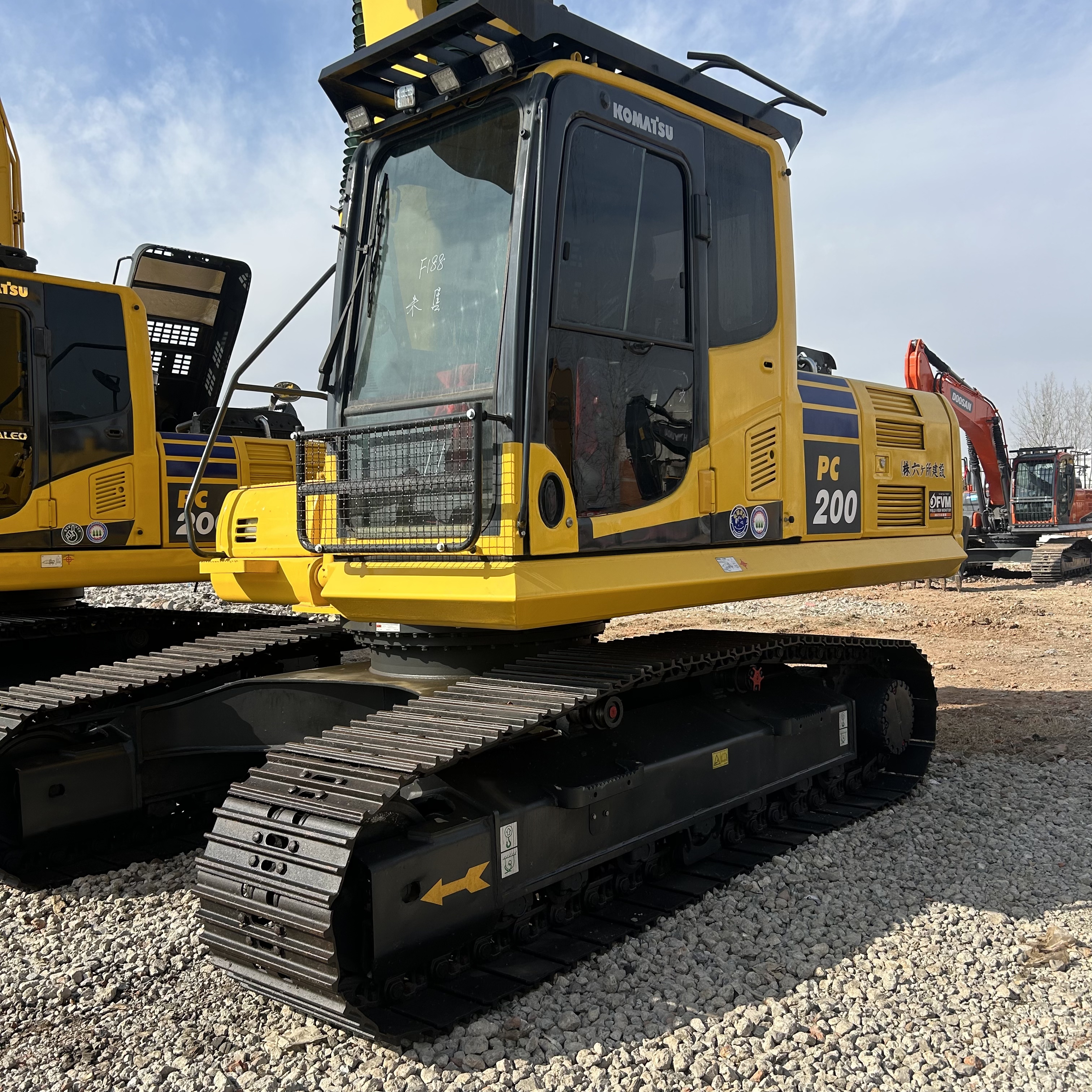
Komatsu excavators—particularly the PC200 series in the 20-ton class—are highly sought after globally for their balance of power, fuel efficiency, long service life, and global parts availability. In China’s second-hand market, used Komatsu PC200 prices typically range from 10,000to10,000to30,000, depending on model generation (PC200-6, PC200-7, or PC200-8), operating hours, condition, and configuration.
Step 2: Verify Before You Commit
Always request the machine’s serial number and cross-check it with Komatsu’s regional database or an authorized dealer. Inspect for genuine decals and matching component serial numbers.
Suppliers who provide transparent documentation—including engine operating hours and maintenance logs, undercarriage wear assessments, hydraulic system pressure tests, and boom structural integrity photos—demonstrate confidence in their inventory. Request real-time video inspections or time-stamped photo updates of critical areas.
Step 3: Understand Total Cost of Ownership
The cheapest initial price rarely delivers the best long-term value. A used excavator with documented maintenance and genuine wear may cost more upfront but will save thousands in unplanned downtime and component replacements.
Used equipment typically costs 25 to 50 percent less than comparable new models, freeing substantial capital for other business priorities. Three-year-old excavators with around 3,000 hours often deliver identical capability to new units at half the investment. But the true advantage of buying used lies in depreciation mitigation—unlike new equipment that loses 15 to 25 percent of its value immediately, used machines have already experienced their steepest depreciation.
Step 4: Create Your Inspection Checklist
Before any purchase, systematically evaluate:
- Structural integrity: Cracks in boom, arm, or frame; quality of any weld repairs
- Undercarriage: Track life remaining, sprocket wear (teeth hooked?), rollers that spin freely
- Hydraulics: Smooth function cycling, drift test results, fluid color (clear amber good; milky bad)
- Engine: Cold start performance, smoke color, unusual noises
- Documentation: Complete service records, hour meter consistency with wear, clean title
Conclusion
The global used and refurbished construction equipment market has evolved from informal sales channels to professional platforms supported by OEM certification programs, which increase transparency and provide financing options for used assets. But no certification program replaces your own due diligence.
When buying a used excavator—whether a Komatsu PC200, Hitachi ZX200, Caterpillar 320, or Kobelco SK200—remember this principle: Hours indicate runtime. Condition indicates remaining life. Balance both, verify everything, and you will secure a machine that drives profitability for years rather than a costly problem parked in your yard.
Why Taihongmachinery (TH Engineering Equipment Limited) Is Your Trusted Partner
At Taihongmachinery (TH Engineering Equipment Limited), we understand that buying a used excavator is a significant capital decision—not just a transaction. With years of experience in global used construction equipment trade, we specialize in premium used Komatsu excavators and other leading brands, including Hitachi, Kobelco, Caterpillar, Volvo, Hyundai, and Doosan.
What sets us apart? Every machine we offer undergoes a rigorous multi-point inspection following our strict quality protocol. We provide complete service records, transparent condition reports, and genuine parts verification—so you know exactly what you are investing in. Our team offers export logistics support, helping you get your equipment delivered anywhere in the world efficiently.
Whether you are expanding your fleet for a major infrastructure project, replacing aging machinery, or entering the construction business for the first time, we are here to help you find the right machine at the right price. Contact Taihongmachinery today to explore our current inventory of used Komatsu excavators, request a quote, or schedule an inspection. Let us help you make your next equipment purchase your most profitable one.